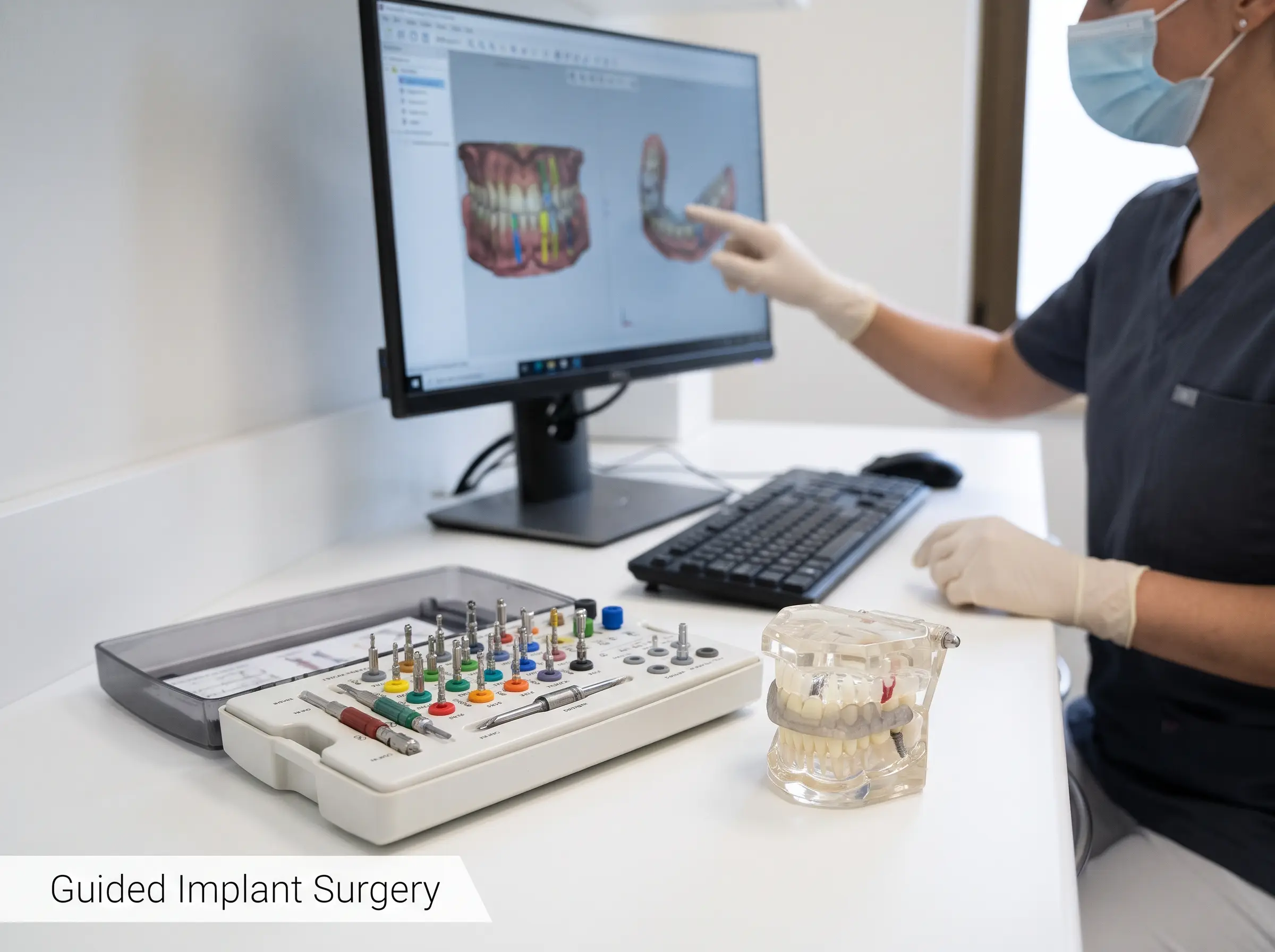
Why Digital Guidance Transforms Implant Dentistry
Traditional freehand implant placement relies solely on the surgeon's visual estimation and tactile feel after cutting open the gum tissue. While skilled hands achieve solid outcomes, anatomical variations can increase surgical risk.
Computer-guided implant surgery merges 3D Cone Beam Computed Tomography (CBCT) bone data with 3D digital surface scans of your mouth. We perform the entire surgical operation virtually on our planning software before touching a surgical instrument. This ensures the titanium implant fixture is placed in the ideal position, depth, and angulation relative to critical nerves, sinus cavities, and surrounding teeth.
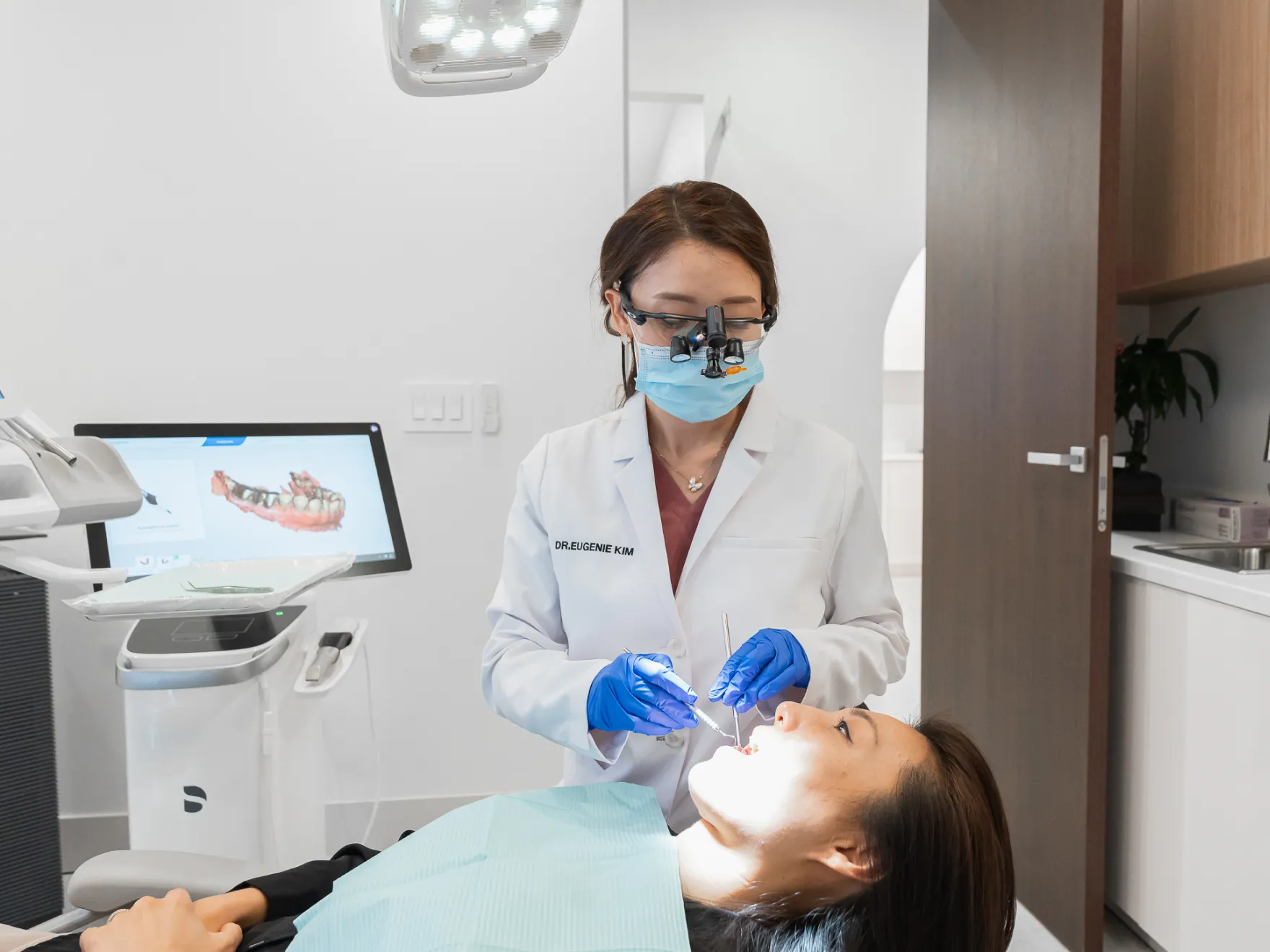
The Key Patient Benefits of Guided Placement
- Minimally Invasive (Often Flapless): Because we know the exact bone geometry underneath the surface, we can frequently place the implant through a tiny "keyhole" opening in the gum, avoiding large incisions and extensive sutures.
- Substantially Less Post-Op Swelling & Pain: Preserving the periosteal tissue translates directly into minimal post-operative soreness, reduced bruising, and less need for prescription painkillers.
- Accelerated Healing & Faster Integration: Precision positioning ensures optimal bone-to-implant contact (osseointegration), allowing for faster soft-tissue recovery and faster delivery of the final tooth.
- Flawless Prosthetic Alignment: A dental implant is only as good as the crown attached to it. Guided planning positions the implant from the perspective of the final tooth, resulting in natural emergence profiles and easier hygiene maintenance.

The Guided Placement Step-by-Step Workflow
- 01
Volumetric 3D CBCT Diagnostic Scan
We capture sub-millimeter anatomical data showing jawbone height, width, bone density, and the exact paths of mandibular nerves and maxillary sinuses.
- 02
Virtual Implant Simulation
Using advanced software, we select the exact implant diameter and length, placing it virtually in the optimal position to support chewing forces and aesthetic contours.
- 03
Surgical Guide Fabrication
The digital plan is exported to a medical 3D printer or milling machine, producing an autoclavable, custom-fit acrylic guide fitted with titanium drill sleeves.
- 04
Surgical Execution
On procedure day, the guide rests securely over your teeth and gums. Specialized surgical drill kits with mechanical depth stops fit into the titanium sleeves, making it physically impossible to drill past the planned depth or drift off-angle.
- 05
Immediate Provisional Placement (When Applicable)
Thanks to the pre-planned digital design, a provisional temporary tooth can often be seated immediately at the time of surgery.
Who Is a Candidate for Guided Implant Surgery?
Guided surgery is suitable for virtually anyone needing single-tooth replacement, multiple missing teeth, or full-arch reconstructions. It is particularly advantageous for:
- Patients with limited available jawbone volume near anatomical boundaries (nerves, sinuses).
- Patients who experience heightened dental anxiety and desire shorter chair time and minimal tissue trauma.
- Patients replacing front teeth in the aesthetic smile zone where fractional millimeter discrepancies impact gum symmetry.
Frequently Asked Questions
Do You Take My Insurance?
We believe treatment decisions should be guided by your individual needs, not insurance restrictions. Our team is happy to assist with questions about treatment fees, insurance claims, and financing options.
- Fee-for-service, out-of-network practice
- Insurance claims submitted on your behalf as a courtesy
- Flexible financing through Cherry, subject to approval
- We do not accept Denti-Cal or HMO plans
Thank you. Our team will reply by email within one business day.
Book Your Appointment Today!
Discover a new approach to
luxury dental care
We will be in touch shortly
Thank you for starting your journey with us. Our front desk will confirm your time within one business day.