
Why Do Wisdom Teeth Often Require Removal?
Wisdom teeth (third molars) are the last teeth to develop, usually emerging between the ages of 17 and 25. Because modern human jaws are frequently too narrow to accommodate these large four molars, they often struggle to erupt properly, becoming impacted.
Leaving impacted or partially erupted wisdom teeth unmanaged can lead to serious oral complications:
- Impaction & Misdirection: Teeth remain trapped beneath the gum and jawbone, growing horizontally or angled into the roots of adjacent healthy second molars.
- Pericoronitis (Recurrent Infections): A partially erupted tooth creates a flap of gum tissue (operculum) that traps food debris and bacteria, causing severe localized swelling, trismus (inability to open the mouth), and painful infection.
- Irreversible Root Resorption & Decay: Impacted third molars press against neighboring molars, eroding their roots or creating hard-to-clean spaces that harbor severe decay.
- Follicular Cysts: Liquid-filled cysts can develop around the crown of an impacted tooth, expanding and eroding the surrounding jawbone tissue and endangering nerve pathways.
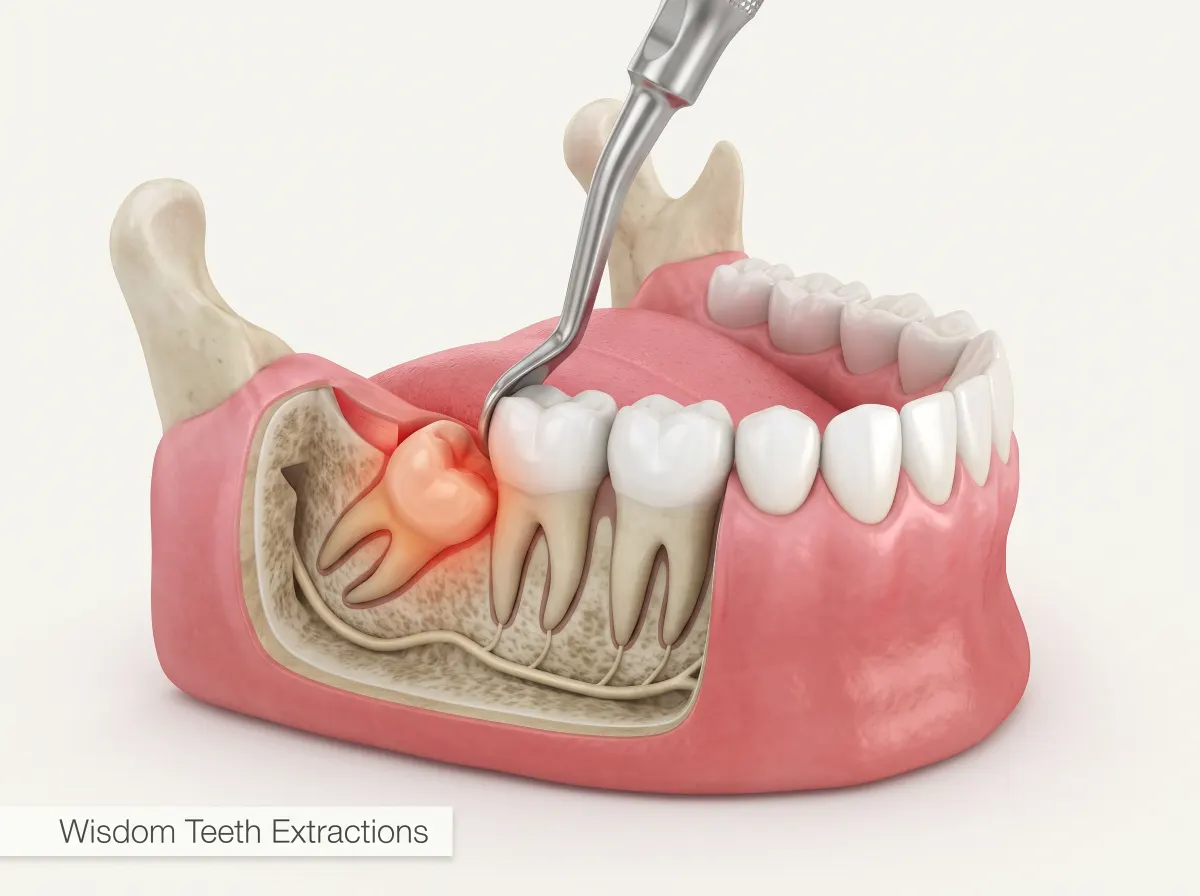
Types of Wisdom Tooth Impaction
- Soft Tissue Impaction
- Gum tissue covers part of tooth; traps bacteria
- Partial Bony Impaction
- Tooth partially emerges; wedged against bone/molar
- Complete Bony Impaction
- Tooth completely entombed within the jawbone
Step-by-Step Surgical & Recovery Protocol
- 01
3D Panoramic & CBCT Mapping
We verify the exact proximity of lower wisdom tooth roots to the Inferior Alveolar Nerve (IAN) canal to ensure safe surgical planning.
- 02
Minimally Invasive Removal
Under your chosen sedation, the tooth is gently exposed and sectioned into small pieces to preserve surrounding jawbone and minimize tissue tension.
- 03
Site Preservation & PRF (Optional)
We can place Platelet-Rich Fibrin (PRF)—derived naturally from a small sample of your own blood—directly into the socket to accelerate healing and dramatically lower the risk of dry socket.
- 04
Resorbable Sutures
Gentle, dissolvable stitches are placed that break down naturally on their own, eliminating the need for suture removal visits.
Sedation & Comfort: Our Anxiety-Free Commitment
Fear of surgical pain should never prevent you from protecting your oral health. We provide tailored sedation options to make your visit completely comfortable:
- Local Anesthesia: Deep, comprehensive numbing of the surgical site so you feel only gentle pressure, never pain.
- Nitrous Oxide ("Laughing Gas"): A fast-acting, mild inhalation sedative that melts away anxiety while keeping you conscious. It wears off within minutes after the procedure.
- Oral Conscious Sedation: Prescription medication taken prior to your appointment that places you into a relaxed, drowsy state.
- Intravenous (IV) Sedation: A safe, controlled "twilight sleep" where you remain comfortable throughout the procedure, waking with virtually zero memory of the surgery.
Home Recovery & Dry Socket Prevention Guidelines
- First 24 Hours: Keep light biting pressure on gauze pads for 45 minutes after leaving. Apply cold ice packs to your cheeks in 20-minute intervals to reduce swelling.
- Protect the Blood Clot (Crucial): Do not use straws, do not smoke or vape, and do not spit vigorously for at least 7 days. Suction can dislodge the healing blood clot, exposing bare bone and causing a painful "dry socket."
- Nutrition Protocol: Stick to cool, soft foods for the first 48 hours (smoothies, creamy yogurts, blended soups, scrambled eggs). Avoid crunchy, seeded, or spicy foods.
- Gentle Salt Water Rinses: Beginning 24 hours post-surgery, gently roll warm salt water around your mouth after meals to keep the surgical areas clean without disrupting the clot.
Frequently Asked Questions
Related Treatments
Do You Take My Insurance?
We believe treatment decisions should be guided by your individual needs, not insurance restrictions. Our team is happy to assist with questions about treatment fees, insurance claims, and financing options.
- Fee-for-service, out-of-network practice
- Insurance claims submitted on your behalf as a courtesy
- Flexible financing through Cherry, subject to approval
- We do not accept Denti-Cal or HMO plans
Thank you. Our team will reply by email within one business day.
Book Your Appointment Today!
Discover a new approach to
luxury dental care
We will be in touch shortly
Thank you for starting your journey with us. Our front desk will confirm your time within one business day.